

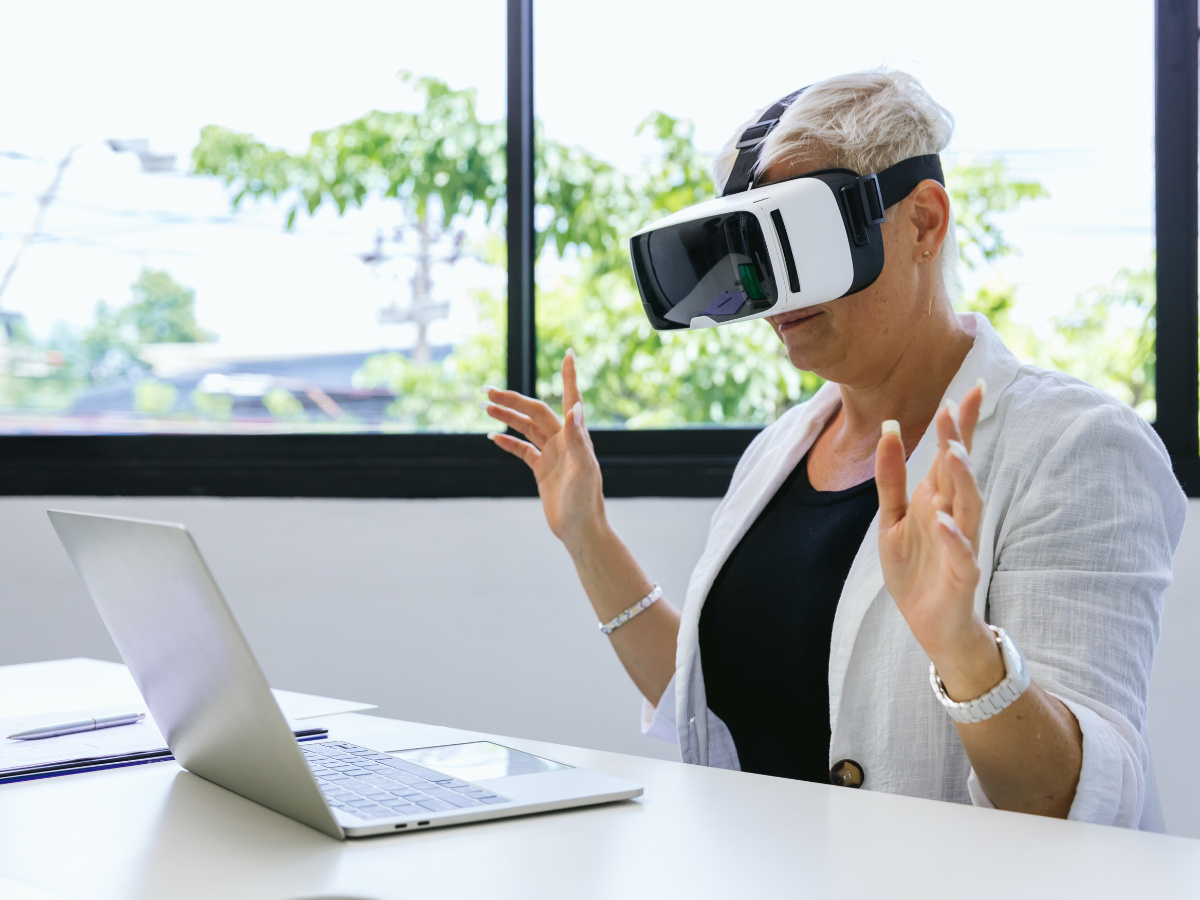
Virtual reality is no longer confined to gaming. In 2026, VR for business has become essential infrastructure, reshaping how organizations train employees, design products, and engage customers across every industry.
The business case is compelling. As hardware costs drop and software platforms mature, VR adoption accelerates beyond early adopters to mainstream enterprise use.
This transformation reflects broader shifts toward remote work and digital-first operations. Organizations leveraging VR for business gain competitive advantages through risk-free training environments, virtual collaboration capabilities, and innovative customer experiences that traditional methods cannot match.
Understanding current applications, proven ROI, and implementation strategies is essential for businesses positioning themselves as industry leaders in an increasingly digital landscape.
The current state of business VR adoption
Virtual reality is reshaping how companies work, learn, and interact in a post-pandemic world. Once viewed as gaming technology, VR for business now transforms healthcare, industrial applications, and virtual collaboration.
Recent data shows 70% of professionals believe businesses will adopt VR/AR technologies. Thousands of companies worldwide now actively deploy XR solutions. VR has moved beyond experiments to become a strategic business tool with proven value.
Key business applications driving VR investment
Immersive training and skill development
Training represents the most compelling use case for VR for business. Virtual reality allows trainees to practice skills in immersive, realistic, risk-free environments. This proves particularly valuable in aviation, surgery, construction, and healthcare.
The impact is measurable:
UPS saw a 75% decrease in training time since adopting VR driver training, with no loss in effectiveness. In education, VR allows students to step into historical scenes or explore space from their classroom. The global VR learning market grew 38% in 2022.
Risk-free environments prove valuable for high-stakes scenarios. New Jersey law enforcement officers use VR systems to train for situations ranging from traffic stops to active threats. The technology delivers electric shocks when trainees make dangerous mistakes, simulating real fear.
Product design and manufacturing innovation
Manufacturing businesses leverage VR for business to revolutionize design and development. Virtual reality simulates every characteristic of parts, processes, and mechanisms. Engineers identify design flaws before creating physical prototypes.
Companies using VR report quicker development and more creative designs with fewer, simpler parts at lower costs. Teams visualize products at full scale, seeing 1:1 virtual models of products, work cells, and production environments. This results in more innovation, flexibility, and productivity.
Remote collaboration and virtual workspaces
XR technologies like VR and AR support remote work and distributed teams. Virtual reality environments help remote teams collaborate by simulating in-person meetings. This capability has become essential for hybrid and distributed work models.
Companies share virtual scenes in real-time and stream 3D data over networks. Teams benefit from collaborative virtual sessions with partners worldwide. This spatial collaboration transcends video conferencing by allowing participants to interact with 3D models together.
Enhanced customer engagement and marketing
VR for business transforms how companies present products and engage customers. Customers can put on headsets and appear in virtual showrooms, interacting with sales assistants and trying products from home.
Retail has particularly embraced this technology. VR in retail grows steadily through virtual try-ons and immersive brand experiences that create memorable customer interactions.
Leading VR technology providers and solutions
The enterprise VR market features several major players offering robust VR for business solutions:
Meta offers Quest headsets with managed solutions meeting SOC 2 compliance standards. Organizations get independent validation of data protection and security, plus two years of Meta Horizon managed solutions with device purchases.
Business VR headsets from Meta, Varjo, Magic Leap AR, HTC, and Pico offer high-fidelity visuals and immersive features for diverse enterprise environments. Businesses can match solutions to specific needs and budgets.
IntegratedXR technologies combining AI, VR, and AR rapidly transform enterprises. They offer solutions to real-world challenges from design review to workforce training and marketing experiences.
PIUP specializes in tailored VR, AR, and MR experiences for UAE businesses, creating ultra-realistic digital twins using advanced photogrammetry and scanning techniques. Our fully customizable solutions serve product showcases, real estate presentations, city visualizations, trade shows, and virtual tours with cross-platform compatibility. With a perfect 5/5 client satisfaction rating on international platforms, we deliver measurable ROI through scalable solutions designed for both niche projects and global deployments.
Measurable business benefits and ROI
Implementing VR for business delivers tangible bottom-line impacts. A 2025 Meta-commissioned study by Forrester Consulting found mixed reality provided significant benefits and net present value over three years.
Economic benefits include:
- Cost savings and increased efficiency
- Immersive, risk-free training environments
- Revolutionary skill development
- Competitive advantages across operations
Organizations report improvements in training effectiveness, reduced travel costs, fewer design iterations, and enhanced engagement metrics.
Industry-specific applications
Different sectors find unique VR for business applications:
Healthcare: Medical professionals use AR Remote Assist, allowing surgeons to call expert trainers during difficult procedures. VR also supports patient therapy and medical education.
Manufacturing: Companies use VR to improve efficiency, cut waste, and prevent problems through virtual factory visualizations.
Education: Institutions leverage VR to create engaging experiences that transport students to any time or location, making abstract concepts tangible.
Real estate and architecture: Professionals use VR for virtual property tours and design reviews. Clients experience spaces before construction begins.
Implementation considerations for VR for business
Successfully deploying virtual reality requires strategic planning. Compared to room-based simulations, VR cuts costs dramatically. However, significant up-front expenses remain, particularly if training needs require bespoke simulations coded from scratch.
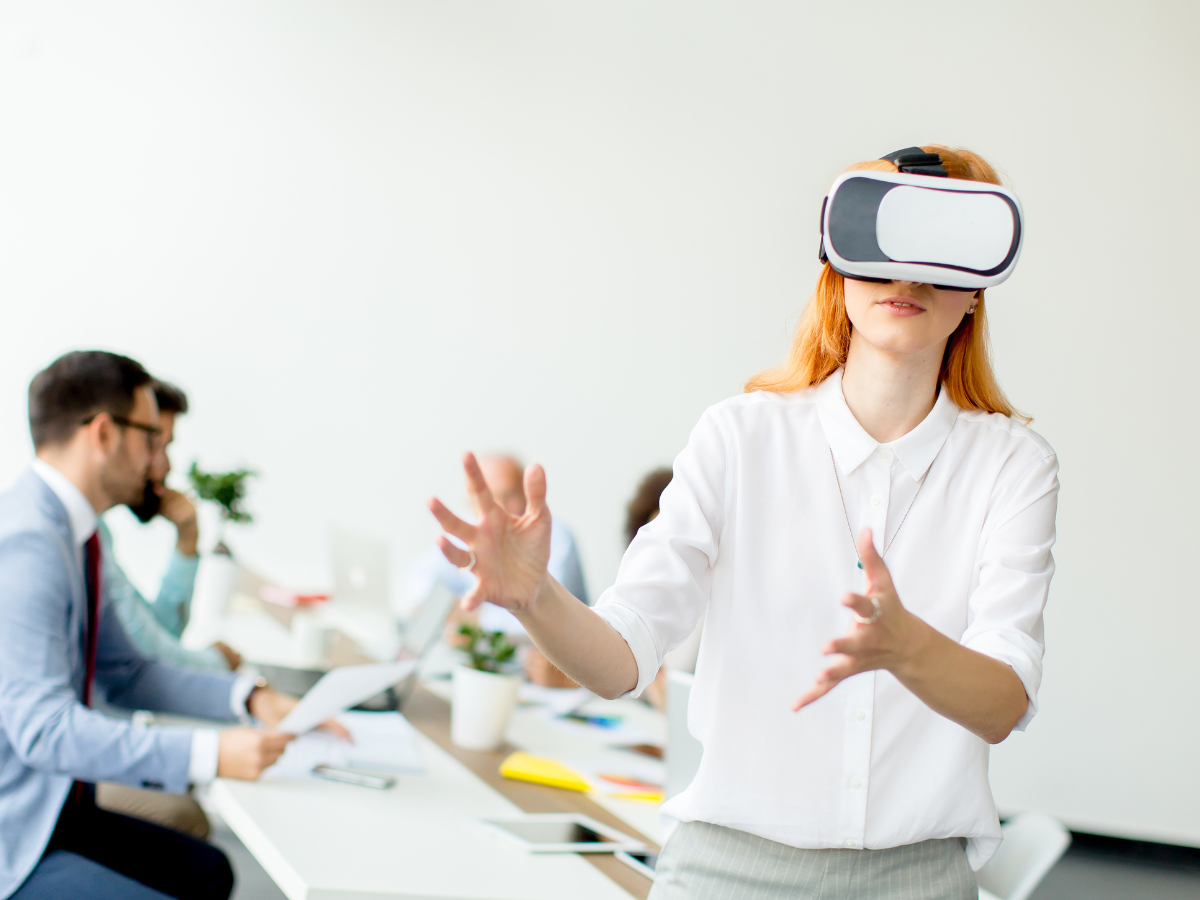
Best practices for implementation:
- Start with phased rollouts using small pilot groups
- Test functionality and identify glitches early
- Refine training materials iteratively
- Gather feedback through surveys, interviews, or observation sessions
- Minimize risk while ensuring solutions meet actual business needs
Businesses benefit from customized XR consulting tailored to specific needs and goals, focusing on measurable results and ROI.
Security and privacy considerations
Enterprise adoption of VR for business requires robust security frameworks. Leading VR providers ensure data safety with managed solutions meeting high privacy and security standards including SOC 2 compliance. This provides independent validation of data protection commitments.
Organizations must evaluate how VR platforms handle sensitive information, particularly:
- Proprietary designs
- Confidential training scenarios
- Customer data collected through immersive experiences
The Future trajectory of business VR
The outlook for VR for business points toward continued expansion and sophistication. From healthcare and education to retail and automotive, virtual reality’s versatility enhances training, customer engagement, and operational efficiency.
As hardware becomes affordable, software platforms mature, and enterprise applications proliferate, barriers to entry drop. Organizations investing in VR now position themselves as industry leaders, benefiting from enhanced training, improved collaboration, and innovative customer engagement.
VR uptake in business is forecast to outpace leisure use, confirming virtual reality as essential business infrastructure rather than experimental technology.
Conclusion: Embracing VR for business success
Virtual reality has evolved from experimental technology to strategic necessity. Companies implementing VR for business solutions gain measurable advantages in training efficiency, product development, remote collaboration, and customer engagement.
The question is no longer whether to adopt virtual reality, but how quickly your organization can implement it to stay competitive. With proven ROI, declining costs, and expanding applications, VR represents a fundamental shift in how modern businesses operate.
Start exploring VR solutions today to transform your enterprise operations and position your organization for long-term success in the digital economy.
Read also: The AI development process: From data to deployment