

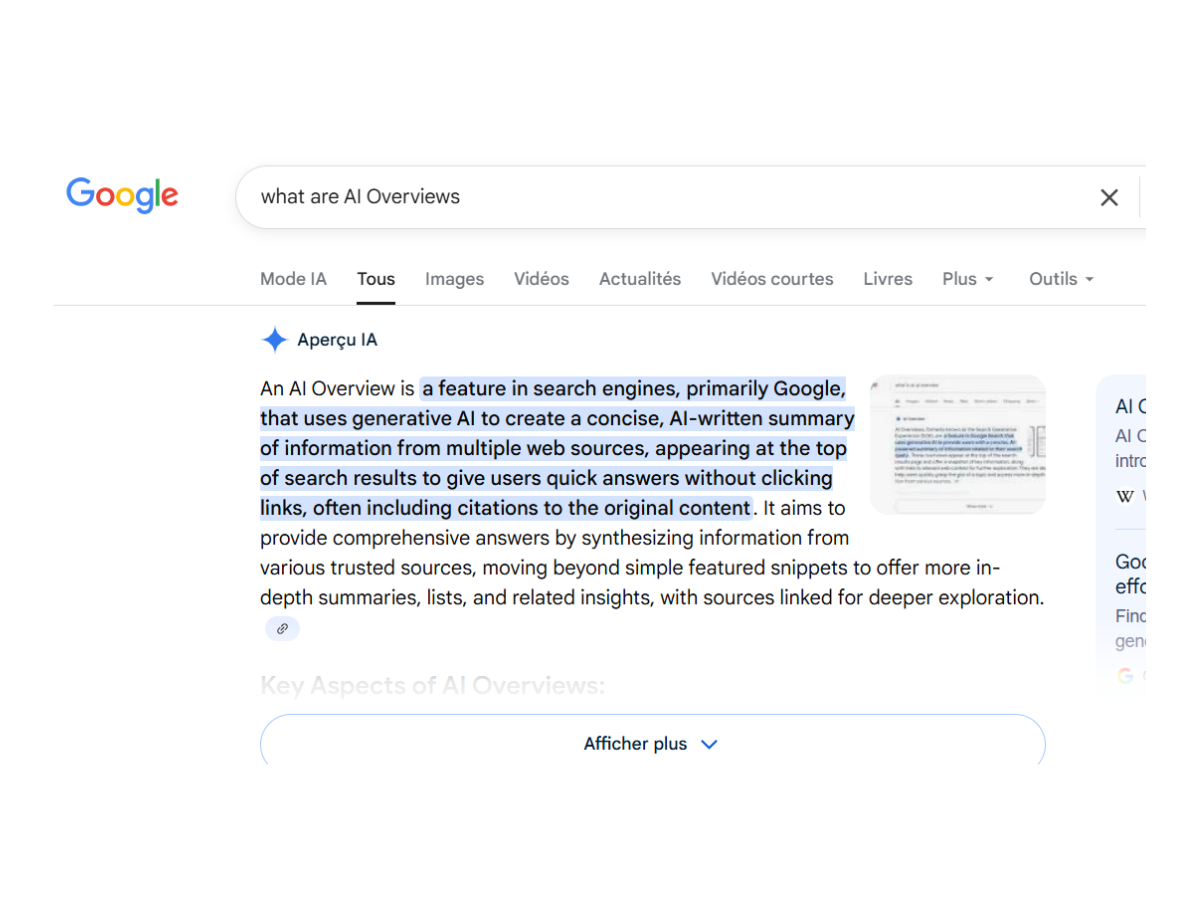
AI Overviews are redefining search. Where traditional SEO focused on ranking links, AI-driven results focus on providing the best direct answer. Instead of listing pages, they synthesize information from multiple sources to generate a final response.
This shift does not eliminate SEO — it transforms it. To rank in these AI-generated summaries, your content must become the most trustworthy, structured and context-rich source available. This guide explains exactly how to achieve that.
Understanding what AI-generated summaries prioritize
Google’s new search experience works differently from classic results. It doesn’t just scan for keywords; it analyzes meaning, relationships, credibility, freshness, and user intent at a deeper level.
To appear in these AI-generated summaries, a website must offer clear, factual, and well-structured content that helps the system form an authoritative answer.
They favor:
- Content written with explicit clarity and depth
- Information supported by evidence
- Clear segmentation and logical flow
- Language aligned with natural, conversational queries
In essence, AI-powered search rewards content that anticipates the question at a human level before the machine even processes it.
Optimize for user intent, not keywords
Keywords still matter, but intent matters more. People are searching in longer phrases, more conversational sentences, and problem-based formats.
Instead of chasing keyword density, focus on mapping the user’s deeper intent. Ask yourself:
- What is the real problem the user is trying to solve?
- What context do they need to make a decision?
- What steps or explanations feel missing elsewhere?
When the content reflects a genuine understanding of the reader’s goal, AI systems identify it as a high-value source.
Create highly structured “answer-ready” content
AI-powered search scans structure as much as text. The more organized your content is, the easier it becomes to extract key ideas.
The best-performing pages use:
- Clear titles that anticipate questions
- Concise introductions that immediately frame the answer
- Paragraphs that go straight to the point
- Logical transitions, not scattered advice
Imagine your page as a well-built map: the machine should understand the solution path instantly.
Write in natural, context-rich language
AI models prefer human-sounding content — not robotic SEO text. They analyze tone, clarity, and contextual richness.
Use an accessible style:
- Explain concepts in plain terms
- Add real examples when relevant
- Clarify implications and alternatives
- Avoid filler language
The more your text resembles a helpful expert explaining something to a real person, the more generative search engines rely on it.
Target conversational queries and long-form variants
People increasingly search using full questions:
“What’s the fastest way to reduce bounce rate?” “How do I file taxes as a freelancer in Dubai?”
AI systems use these queries as primary anchors. To rank, incorporate natural questions throughout your content, and answer them immediately.
Rather than creating dozens of pages, one well-built long-form article that logically covers multiple related questions performs far better.
Demonstrate expertise and factual solidity
AI-generated summaries are designed to avoid hallucinations by relying on content that looks factually grounded.
You increase your chances of being cited when your content:
- Refers to credible statistics or external sources
- Includes clear definitions
- Explains reasoning, not just conclusions
- Uses precise terminology when needed
Credibility isn’t about bragging — it’s about showing your work.
Use schema to clarify, not to overload
Structured data helps AI interpret your content with precision. But over-optimizing with endless schema types isn’t necessary.
A clean implementation of:
- Article schema
- FAQ schema
- HowTo schema (only when genuinely relevant)
…is usually enough to signal clarity and relevance.
The goal is to help AI categorize your page, not to drown it in metadata.
Update content frequently to signal freshness
AI-powered search prioritizes information that feels up-to-date. Even evergreen topics benefit from recent refreshes.
You don’t need to rewrite your content; small updates like:
- Adding a recent statistic
- Incorporating a new example
- Slightly refining the phrasing
…are enough to push your freshness score higher.
Strengthen semantic authority on the topic
AI systems reward websites that demonstrate depth across an entire theme. This is what is called semantic authority.
Instead of writing isolated articles, build clusters:
- A pillar page offering the full overview
- Supporting pages exploring subtopics in depth
AI recognizes when your site is the most complete source in the niche — and chooses it accordingly.
Build trust signals throughout the site
Ranking in AI-generated search is easier when the whole site looks trustworthy, not just a single page.
Trust can come from:
- Transparent author bios
- Visible expertise
- Clear sources
- Privacy pages
- Clean design and fast performance
If a user feels safe consuming your content, the machine learns to trust it too.
Combine GEO (Generative Engine Optimization) with SEO
SEO alone is not enough in 2025. GEO — Generative Engine Optimization — is becoming essential.
GEO focuses on optimizing content for AI-driven answers rather than classic ranking.
To align with GEO principles:
- Write for natural conversation
- Emphasize clarity over complexity
- Anticipate multi-question queries
- Structure information like building blocks
- Deliver value before decoration
When SEO brings traffic and GEO brings visibility in AI summaries, your digital presence becomes unbeatable.
Conclusion: The future of ranking is being the best answer
AI-generated search results are not a threat — they’re a filter that elevates the clearest, most helpful content.
To rank, your page must simply become the best possible explanation available.
Not louder. Not longer. Just better.
FAQ
How long does it take to rank in AI Overviews?
There is no fixed timeline. Some pages appear within days if the topic is new or under-covered, while competitive topics may take weeks. The key factor is not time but content clarity, authority, and freshness. When your page becomes the most complete and answer-ready source, AI-powered search picks it up quickly.
Do backlinks still matter for AI Overviews?
Yes — but differently. AI systems don’t rely on backlinks as ranking signals the way classic search does. Instead, they use them as trust indicators. A page with credible references, mentions from reputable sites, or citations online appears more reliable to generative models, which increases the likelihood of being included in AI-generated summaries.
Should I write shorter or longer content to appear in AI Overviews?
Length is not the deciding factor. What matters is how well the content answers the question, how clearly it is structured, and how efficiently it anticipates related queries. A long article that wanders will perform worse than a concise one that explains everything the user needs. Aim for complete, not long.