

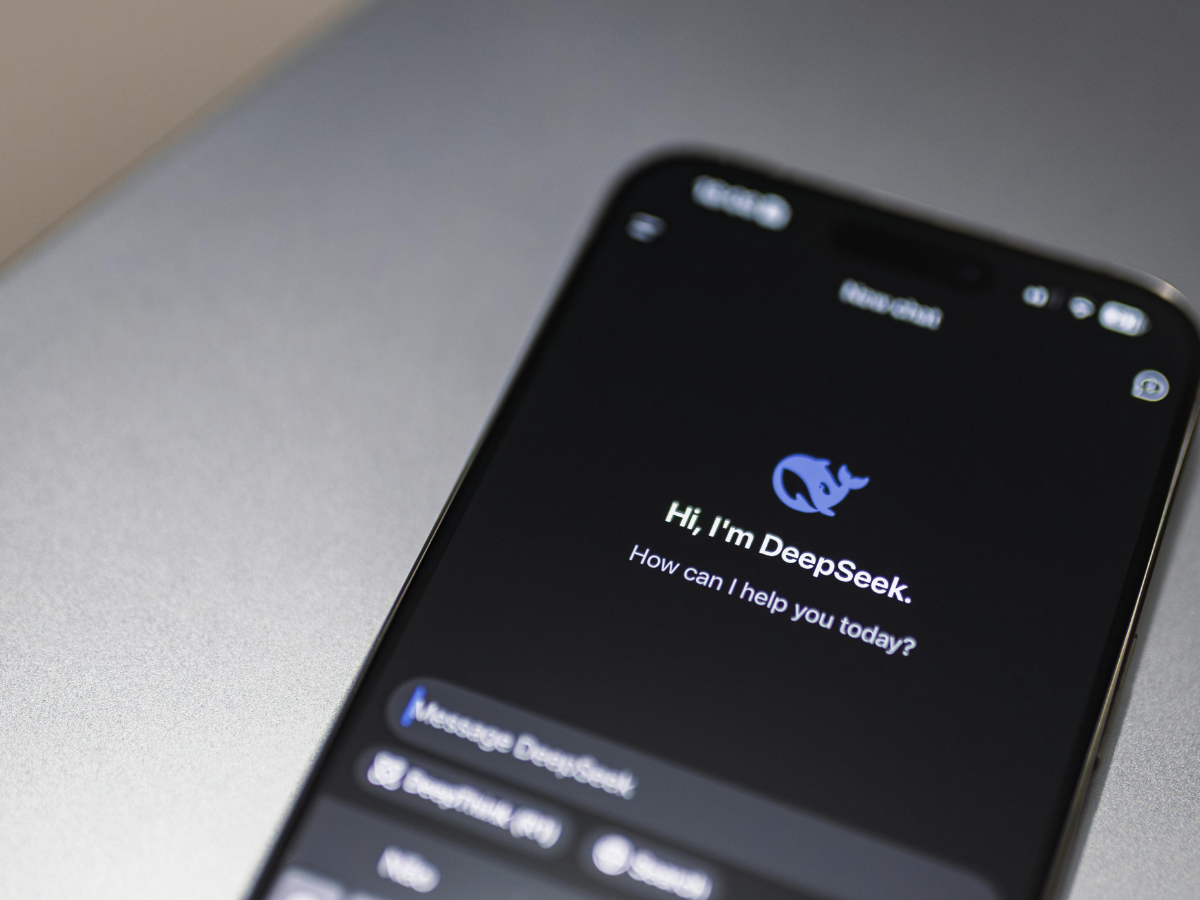
Deep Seek has quietly released a new AI model, with no press release or fanfare. But a bigger question is echoing across the tech world: the global AI race : is China about to overtake the U.S? For years, China lagged behind. Now, it’s catching up fast. Open-source innovation, hardware breakthroughs, and returning talent are accelerating its progress. Companies like Deep Seek are launching powerful AI models at record speed. Chinese dominance in AI no longer feels like a distant threat—it feels close.
The global AI race : China’s AI surge in 2025
One of the dominant themes in the 2025 AI conversation is the rivalry between China and the United States.
Deep Seek has released a new AI model. China now builds high-performance chips. Top AI scientists are also returning home. Experts wonder: Is China taking the lead in the global AI race?
So far, the new Trump administration has offered few concrete AI policies beyond a commitment to “stay out of the way” of U.S. AI companies.
Where a clear political objective does exist, it is simply that China must not win this technological race.
“Sputnik Moment” of AI
Deep Seek’s R1 model jolted Washington. Policymakers and the public saw that China is rapidly closing the AI gap.
The event was so striking that Mark Andre even referred to it as AI’s “Sputnik moment.”
Just a few months later, it now appears that China—if not already in the lead—is moving at a much faster pace than its American competitors are.
While Deep Seek served as a warning shot in the West, it became a national sensation in China.
The following months were filled with adoption stories and what appears to be a coordinated national push to integrate Deep Seek into virtually everything.
The new Deep Seek V3 model
One major development is the quiet release of Deep Seek’s new foundation model, V3 MOD. This open-source model was uploaded to Hugging Face just yesterday—with no formal announcement, no press release, and not even a README file. Only the model weights and a commercial-use license were provided.
Benchmark tests suggest significant improvements in reasoning and coding.
Despite the buzz, this isn’t Deep Seek’s upcoming reasoning model. That model will likely be called R2. Many experts are eagerly awaiting R2.
Impressive efficiency and speed
What is truly making headlines is the model’s efficiency and speed. Apple machine learning researcher Ani Hannan tested it on an M3 Ultra Mac Studio with 512 GB of RAM and reported inference speeds of 20 tokens per second. Granted, that is in 4-bit mode and on a $9,500 machine—not exactly consumer hardware—but it is still a cutting-edge 685-billion-parameter model running on a desktop that costs less than a used car.
As VentureBeat put it:
“This represents a potentially significant shift in AI deployment. Traditional AI infrastructure typically relies on multiple Nvidia GPUs drawing several kilowatts of power. The Mac Studio, by contrast, uses under 200 watts during inference. This efficiency gap suggests the AI industry may need to rethink its assumptions about the infrastructure required for high-performance models.”
Strategic differences between east and west
VentureBeat also highlighted a fundamental divergence in AI strategies between the East and the West.
While U.S. leaders like OpenAI and Anthropic have kept their most advanced models locked behind paywalls, Chinese companies have largely embraced open-source development.
“This approach is rapidly transforming China’s AI ecosystem. The open availability of cutting-edge models creates a multiplier effect, enabling startups, researchers, and developers to build on sophisticated AI technology without massive capital investments. It has accelerated China’s AI capabilities at a pace that has shocked Western observers.”
The report continues:
“This philosophy is quickly narrowing the perceived AI gap between China and the U.S. Just a few months ago, most analysts believed China lagged one to two years behind the U.S. in AI. Today, that gap may be down to just 3–6 months, with some areas approaching parity or even Chinese leadership.”
If Deep Seek continues its previous release pattern, we may see a new reasoning model (Deep Seek R2) in the coming weeks. The rumor mill is already buzzing, with sources like Smoke Away claiming R2 scored 90% on the RCGI benchmark—higher than OpenAI’s O3, which reportedly scored 87%.
As Chubby wrote:
“That would be absolutely wild and would catapult China ahead. If it’s true, I don’t see how the closed-model approach can win the AI race now.”
Still, many have pointed out that this rumor is unverified and likely false. However, perhaps more important than the truth of the rumor is what its spread signals: a dramatic shift in global perception of China’s role in the AI race.

The global AI race : China closes the gap on AI chips
China is also catching up on the hardware front. According to Bloomberg, Alibaba’s parent company, Ant Group, has developed a technique that reduces training costs by 20% using Huawei’s AI chips.
Ant Group adopted a Mixture of Experts (MoE) architecture—the same architecture powering Deep Seek’s models.
The most notable revelation, however, is that Ant achieved these results on training runs using Nvidia’s H800 chips—a downgraded version designed to comply with U.S. export controls. This suggests that Huawei’s chips can now effectively substitute American GPUs, making those export restrictions far less effective than previously thought.
Ant Group published its process in a research paper earlier this month, outlining its goal to scale frontier LLMs without using premium GPUs.
According to the company, training a trillion-token model on high-performance hardware cost around $880,000, but using their optimized method on more accessible hardware could bring the cost down to $700,000.
Bloomberg senior analyst Robert Lee commented:
“Ant Group’s paper highlights the growing innovation and accelerated technological progress in China’s AI sector. Their findings show China is heading toward AI self-sufficiency. They are moving to cheaper, more compute-efficient models. This helps them bypass Nvidia chip restrictions.”
Former quant investor Jeffrey Emanuel added:
“Well, that didn’t take long. Huawei’s AI training chips are barely on the radar of U.S. firms and public market investors, but they should be—more than 40% of Nvidia’s real sales still come from China, including via Singapore and Vietnam through grey-market channels.”
Huawei, meanwhile, is very much on Nvidia CEO Jensen Huang’s radar. Speaking last week, Huang said:
“Huawei is the most formidable technology company in China. They have conquered every market they have entered. I believe their presence in AI grows every year. We cannot assume they won’t be a major player.”
The race to keep AI talent
A troubling new front in the U.S.–China AI rivalry is talent retention. A recent Republican bill proposing to bar Chinese students from U.S. universities caused a stir, with many warning it would choke off the talent pipeline.
An even more pressing issue: top Chinese AI scientists are starting to “self-repatriate.” Guan Chi, 43, a former Microsoft researcher and chief AI scientist at Huawei Research USA, has returned to China to join Westlake University in Hangzhou after a decade in the United States. During his U.S. tenure, he earned multiple honors, including the Microsoft Fellowship, the IBM Fellowship, and a Best Paper Award at ACM MM.
“I was drawn by Westlake’s free academic atmosphere and wanted to pursue what I truly care about,” Chi said.
A UK medical-AI researcher based in China, going by Luke, commented:
“Huge AI news in China. Dr Chi is an AI legend. His move from the U.S. back to China should be a major wake-up call for friends in AI research.”
A Chinese observer, Dai WW, wrote:
“The U.S. AI industry faces a dilemma: Without Chinese engineers its AI will lag China’s; with them, those engineers may eventually return home.”
The talent competition is real. In 2022, 47% of the world’s top AI graduates came from China. The United States produced about 18%.
Liberal commentator Matt Yglesias summarized the challenge:
“Nobody wants to hear it, but it’s hard for America to field more people than China in AI, batteries, drones—anything critical—when the Chinese population is four times larger. You need sheer numbers.”
The fight for talent may prove as decisive as hardware, funding, or policy in determining who leads the next era of artificial intelligence.
Read aslo: 10 concrete examples of artificial intelligence in business